AfterClass
A Team-Creation Website for Ambitious Students
For Drivhuset Ideathon 2026, my friends and I formed Team Likeable, and together we created AfterClass: a website that allows students to find interdisciplinary teams for personal projects.
AfterClass went on to win the Drivhuset 2026 Ideathon.
01 / Background
AfterClass was built for the Drivhuset 2026 Ideathon, which came with some restrictions regarding both the subject of the design and the tools we could use. We were required to prototype using Lovable, and a number of example problems were provided as starting points.
After looking at the themes in those examples, we decided to formulate our own problem based on our own experiences.
Because the Ideathon lasted only 24 hours, there was very little time for proper user testing. We therefore decided to design for a group we already understood well: university students.
Problem
University students in IT lack a clear channel for finding like-minded people with complementary skills to work with on projects outside of university.
Solution
A website where students select a role they want experience in, then either start their own project or join someone else’s.
Goal
Our goals for the Ideathon were to:
- Reach the top five teams and pitch in front of the jury and audience.
- Create something we would want to continue working on after the Ideathon.
02 / User Needs
To better understand the pain points students faced, we narrowed the scope further to students in IT, since this was the group we knew best.
The design industry is currently going through major changes, and no one really knows what the future will look like. Anxiety around whether you are doing enough during your studies was something everyone in our group could relate to. Uncertainty about the job market was also something we knew from experience was a common topic at our university.
This obviously was not the highest level of research. Much of it consisted of discussing our own experiences as students. Still, we believe this approach worked well within the constraints of a 24-hour Ideathon. It gave us a user perspective to discuss in our pitch, while many of the other projects focused more heavily on the idea itself.
The strongest point of agreement in our discussions was that it can be difficult for university students to gain experience working on projects outside regular coursework.
During our studies, for example, we work on many projects with other interaction designers, but rarely with programmers, project leads, visual designers, or people from other disciplines.
In our quick desk research, 10 out of 10 job postings for UX roles mentioned teamwork as a desired quality.
We therefore arrived at a simple conclusion: as students, we need somewhere to gain experience working with people outside our own field.
This led to our main question:
How can we help and inspire students to gain experience outside regular coursework?
Understanding the Existing Space
We started with desk research, looking at existing platforms and trying to find a space where AfterClass could offer something different.
One of the main things we noticed was the lack of spaces built specifically around students. Existing services for finding teams tend to focus on building products, companies, or startups. We wanted the main value to be gaining experience by creating something together.
Students are also a pretty unusual group in that many of us are willing to spend our free time working on projects without expecting to get paid.
Platforms such as LinkedIn can help people discover opportunities, but they also rely heavily on already having a network. We wanted AfterClass to work for students who didn’t already have a large number of connections.
The idea was that anyone should be able to find other students and simply start building something.
Based on our desk research, our own experiences, and a brainstorming session, we established three main user needs.
Gaining Experience
Many jobs require previous experience, creating the familiar problem where students need experience in order to gain experience.
Personal projects can provide a way around that.
Academic Projects Are Different
We did not speak directly to recruiters during the Ideathon, so this remained an assumption rather than a validated finding.
However, we believed that projects created on your own initiative could demonstrate something that mandatory coursework does not: the motivation to create something simply because you wanted to.
Easier Than Ever to Create, Harder Than Ever to Find Others to Create With
AI tools have made it possible for smaller and less technically experienced teams to build things that previously would have required considerably more technical knowledge.
This makes it easier than ever to work on projects alone. That does not necessarily mean working alone produces the best outcome.
We wanted to help students find others to create with.
03 / Design
User Flow
With the goal of creating a place where IT students could find each other, we created a user flow for the platform.
This also helped us divide the work within the team, as each person could take responsibility for different parts of the experience while still working from the same overall flow.
Visual Style
We spent part of the Ideathon working together in FigJam to create a shared moodboard for the visual direction of AfterClass.
From this, we created:
- A colour palette
- Illustrations for each user role
- Typography and general visual direction
- Reference designs for key components and pages
This acted as a lightweight style guide. When new pages were created, both we and Lovable could refer back to it to keep the website visually consistent.
Allowing myself to be a little meta, we deliberately chose a cheerful pastel palette partly because we wanted the website to feel relaxed and welcoming, but also because we wanted it to look different from what we expected most Lovable-generated websites to look like.
When given very little visual direction, AI website builders have a tendency to produce a polished, futuristic, dark-mode aesthetic.
We wanted AfterClass to feel like our design, not like a default AI-generated interface.
Wireframe
Before any visual styling, I created the first wireframe of the homepage. The goal was to test the page as a short conversation rather than a traditional landing page: a headline that explains what AfterClass is, followed by a question that asks who you are and what you came here to do.
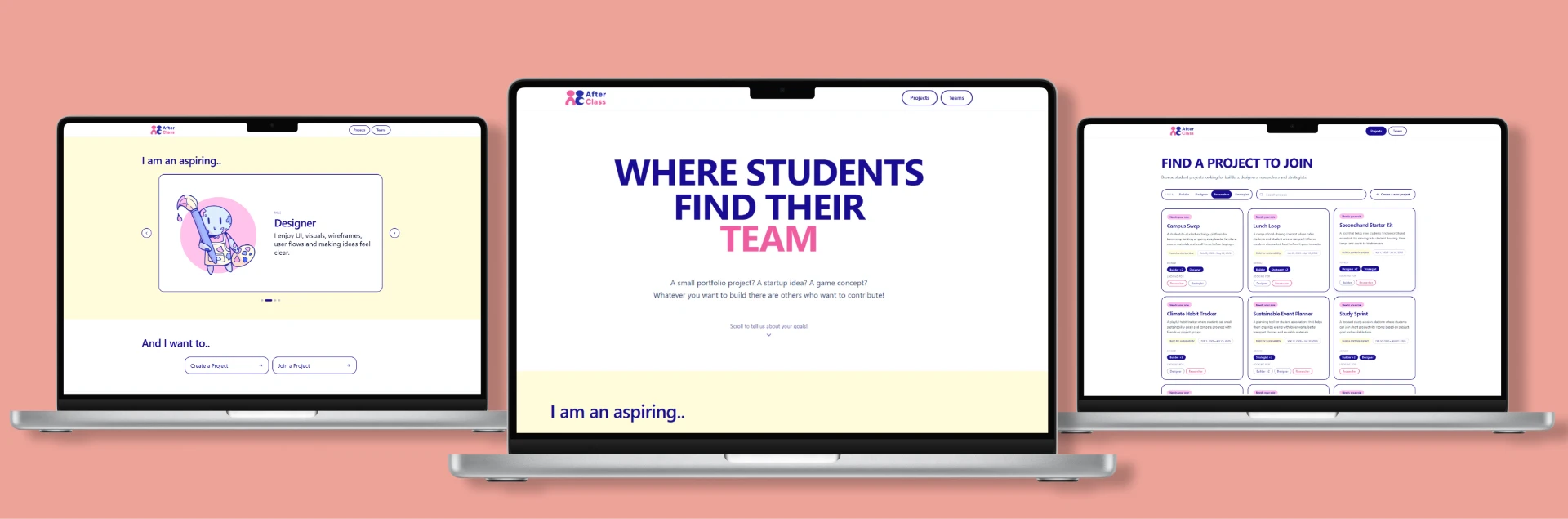
Role selection was part of the structure from this first sketch. "I am an aspiring.." appeared as three cards - Researcher, Builder and Designer - where the selected card opened up to show an illustration and a short description of that role. Below it, "And I want to.." offered two directions: build my own idea, or contribute to someone else's project.
The layout survived partly, but the role selection was simplified in favor of a simpler carousel.
04 / Onboarding
The part of the user flow I personally spent the most time designing was the onboarding experience.
Because AfterClass was specifically intended for students who wanted to gain experience, the onboarding needed to communicate that users did not already have to be experts.
We identified two main decisions a user needed to make:
- Which role do I want experience in?
- Do I have an idea I want to realise, or do I want to join someone else’s project?
The wording of the first step was especially important. Unlike something like LinkedIn, users should not feel that they need to qualify for the role they select.
Someone selecting Developer, for example, is not saying: “I am an experienced developer.” They are saying:
“This is the role I want experience in.”
The goal was to use language that encouraged students to join projects rather than making them feel that they were not experienced enough.
This also influenced our decision to keep the role categories fairly broad, since students rarely have the same level of specialisation as professionals already working in the industry.
05 / Final Design
The final prototype allowed students to explore projects, select the type of role they wanted experience in, create their own projects, and find teams looking for people with their skills or interests.
06 / Results
AfterClass won the Ideathon.
AfterClass went on to win the Drivhuset 2026 Ideathon.
After first being selected as one of the top five teams, we pitched the project in front of a jury and an audience.
Based on the feedback we received, two of the strongest reasons behind the result were:
- The problem was highly relevant to the user group we had chosen.
- The visual design felt well-developed and inspirational.
For a project created in approximately 24 hours, this was a strong validation that the central idea and the way we communicated it were working.
07 / What We Learned
Designing for a world where AI exists is different from designing a product that integrates AI.
A large number of projects currently try to make AI itself the main feature.
AfterClass instead responded to a change partly caused by AI: it has become much easier for small teams to create digital products.
We found this type of relationship with AI much easier to explain and justify.
Understanding the user group is the hardest part of a 24-hour project.
With so little time available, choosing a user group we already understood intimately was one of the most important decisions we made.
It allowed us to spend more of the limited time actually designing rather than trying to understand an unfamiliar context from scratch.
AI tools have a lot of potential for rapid prototyping.
Using Lovable allowed us to create a surprisingly complete prototype within the 24-hour timeframe.
At the same time, we found that giving the tool a clear visual language and custom style guide was important. With enough visual direction, AI-assisted development does not have to result in something that looks generic or obviously AI-generated.

08 / Going Forward
What We Would Do Differently
Formal interviews with students would have given us a clearer and more reliable basis for the user needs we identified. Given more time, this would be the first thing we would address.
We would also want to test whether students actually understand the distinction between selecting a role they are already skilled in and selecting a role they simply want more experience in, since this idea is central to the onboarding experience.
The Future of AfterClass
Part of the prize for winning the Ideathon was a meeting with SU Ventures to discuss the project, potential investment, and whether there was an opportunity to continue developing AfterClass.
We wanted to leave with an idea we genuinely wanted to keep working on.
AfterClass became exactly that.