Skate Nation
Designing a Planning Tool With Skate Coaches
A four-week university project in Participatory Design, developed together with coaches from Skate Nation. The project used four methods: understanding the coaches' work, imagining alternatives, prototyping with participants and evaluating a final app concept.
01 / Context & Design Space
We started by looking at the coaches' work before deciding on a product idea.
Skate Nation is a nonprofit organisation that uses skateboarding to support movement, community and integration among young people. Our participant group consisted of Skate Nation coaches, who teach and support skaters during organised sessions and events.
The course required us to create a digital service, while the problem itself was left open. We therefore began by trying to understand the coaches' work before deciding what the service should be.
We considered involving skaters as participants as well, but the practical difficulties of working with minors and maintaining access across several sessions meant that the project focused on coaches. That decision gave us a clear participant group, but it also became an important limitation later in the process.
02 / Contextual Inquiry
We observed and interviewed coaches in the place where their work happens.
What we did
Our first method combined observation with semi-structured interviews. We visited Skate Nation's weekly beginner session at Fryshuset and observed the coaching environment while it was in use.
I was the only person in our group without previous skateboarding experience, so I took part as a new skater. I approached a coach and asked to be taught the basics while the rest of the team observed from the sidelines. This gave us both a beginner's perspective and an external view of how coaches behaved during a normal session.
We also interviewed four coaches about their work, including scheduling, booking, marketing and their broader experience of being a coach. The interviews were semi-structured, giving us room to follow up on topics that appeared important to the participants.
Analysis and result
Notes from the observations and interviews were combined in an affinity diagram. The early analysis showed recurring concerns around reaching new skaters and adapting the organisation's work to people who were new to Sweden. These clusters became part of the material we brought into the next method.
Method reflection
One member of the design team already knew some of the coaches from previous work. That made parts of the conversation more relaxed, but it also made the intended researcher-participant relationship harder to maintain. It was a useful reminder that familiarity can both help and complicate research.
03 / Future Workshop
We used the coaches' understanding of their current work to imagine better ways of working.
What we did
The Future Workshop helped us move on from describing the current situation and start imagining what could change. The workshop was structured around three phases: critique, fantasy and implementation.
The coaches first discussed problems in their current work. In the fantasy phase they were encouraged to think more freely about what a better situation could look like. In the implementation phase we brought those ideas closer to something that could be represented as a digital service.
My role was primarily to moderate the workshop and keep the phases separate, especially making sure that the critique phase did not immediately turn into solution-making.
Storyboarding
The participants then created paper storyboards of possible solutions. The drawings did not need to look like professional interfaces. Their purpose was to make ideas concrete enough to discuss, compare and react to.
What changed
The workshop gave the project a clearer direction. A recurring issue was that coaches, especially newer ones, did not always have a clear structure for what was expected of them during sessions.
Two ideas became especially relevant: a system where coaches could see upcoming sessions and plan activities inside them, and a system where coaches could see information about the people attending, including whether someone was a first-time skater.
Selected user needs
- Inexperienced coach
I want sessions to be scheduled more precisely, so it is easier to know what is expected of me.
- Experienced coach
I want to know which coaches are available at what times, so I can plan sessions accordingly.
- Coach
I want to know beforehand which members are new, so I can greet them and make them feel welcome.
Method reflection
I noticed that my first reaction to many ideas was to evaluate how difficult they would be to build. Acting as moderator forced me to hold that reaction back and let the participants develop their ideas first. It made me more aware of how quickly technical feasibility can narrow a design space.
04 / Prototyping With Participants
This method helped us work out the structure and flow of the service.
What we did
The third method focused on how the digital service should actually work. Using Balsamiq, participants created low-fidelity wireframes of the views and functions they thought were necessary.
Before the session, the prototyping workspace was prepared and the participants were introduced to what wireframes were for. They were reminded that the goal was to make functionality, order and structure visible, and that visual polish did not matter.
Participants thought aloud while creating their wireframes. When they were finished, they presented the designs and commented on what they understood and liked in each other's prototypes. We saved the wireframes and documented recurring functionality.
What changed
The wireframes gave us a clearer picture of which functions participants considered most important and what order felt natural to them. They also showed that not every coach needed the same thing. Newer coaches were more concerned with guidance and expectations, while more experienced coaches were interested in a broader overview of future sessions and previous activity.
This method also changed my assumptions about the visual direction. I had imagined something more expressive and influenced by skate culture, with a punk or brutalist style. The participants were much more interested in simplicity and a straightforward flow. Making their work easier was more important to them than an expressive look.
Design shift
We changed direction and focused on a tool that reduces friction in the coaches' everyday work. Inspiring coaches visually became less important.
05 / Evaluation With Participants
We tested whether the prototype made sense without explanation.
What we did
For the final method, coaches evaluated a higher-fidelity prototype. Each member of our four-person team showed the app individually to a coach and documented feedback and observations.
We deliberately avoided explaining the interface while they used it. We wanted to see whether the layout, icons, colours and functions communicated their purpose on their own, and whether the coaches recognised ideas that had emerged during the earlier stages.
Evaluation result
Keep
- Register for sessions
- See which coaches are already registered
Change
- Visualisation of how many participants have signed up
Remove
- Detailed profile editing
The evaluation also exposed a mismatch between our design team's vision and some of the coaches' expectations. The app could make planning more structured. However, several coaches expected the skaters themselves to be more visible in the system. This connected directly to an earlier limitation: the skaters had not been part of the participatory process.
06 / Final Prototype
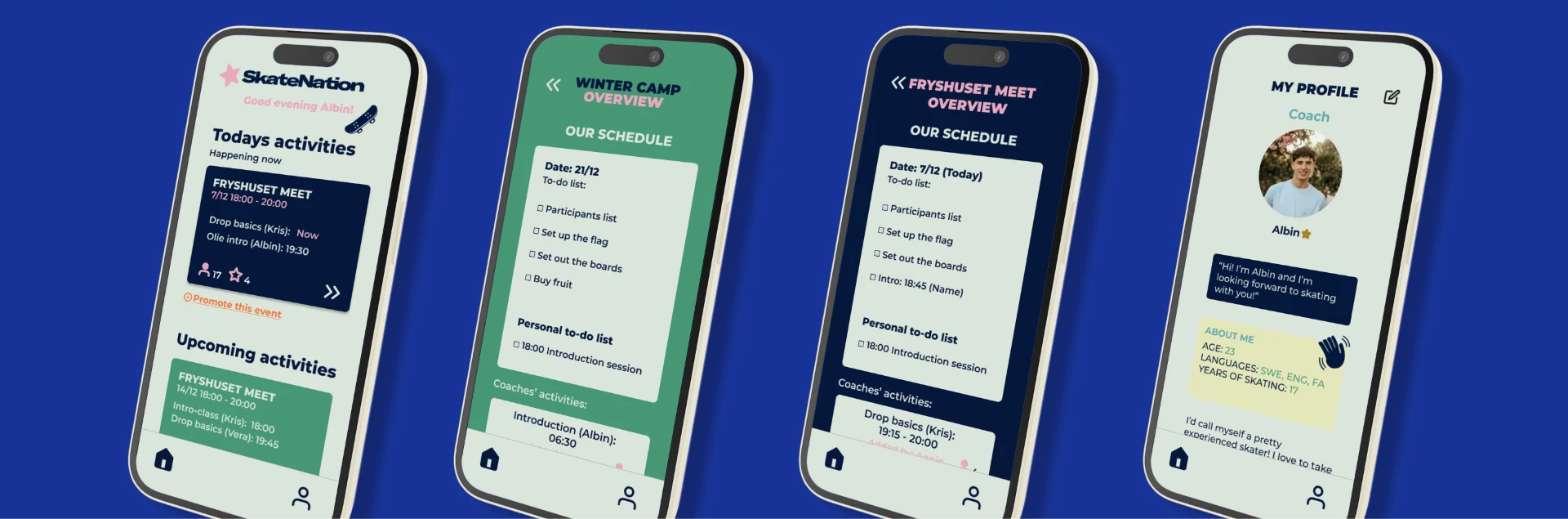
The Skate Nation App focused on planning, coordination and preparation around sessions.
The final prototype was designed as a mobile planning tool for Skate Nation coaches. It brought together upcoming sessions, coach availability, information about expected participants and tools for planning activities.
Upcoming Events
The home view gave coaches an overview of upcoming events, including how many coaches were already booked and how many people had shown interest. This made it easier to judge where extra support might be needed.
Event Details
The Event Details view became the most important screen in the prototype. It combined the event information with attending coaches, an activity planner, the number of interested skaters, first-time skater information and an attendee breakdown.
The intention was to give coaches enough information to prepare for the people attending. If many first-time skaters were expected, for example, coaches could plan simpler activities or decide that another coach should join the session.
Visual direction
The visual design became deliberately less stylised than some of our early ideas. Feedback suggested that the coaches valued simplicity and familiarity more than an expressive skate aesthetic. The interface therefore used a fairly conventional mobile-app structure, while bringing in Skate Nation's colour palette.

07 / Reflection
Looking back, the process changed the solution a lot.
Participatory design changed the solution
After the first research stage I already had a clear idea of how I thought Skate Nation's problems should be solved. Working through the later methods repeatedly challenged that idea. The final prototype was much more grounded in how the coaches actually described and organised their work than the solution I would have produced on my own.
This changed my view of the designer's role. I see it as bringing together different experiences, priorities and constraints from the participants and turning them into a coherent design.
Participant continuity was difficult
The same coaches did not participate throughout the entire four-week process. Scheduling around the team and the coaches was difficult, and only one coach took part in all four methods. That meant later participants sometimes had to be introduced to findings they had not personally helped create.
If I repeated the project, I would plan participant recruitment and scheduling across the entire process from the start rather than arranging each workshop separately.
We only designed with one side of the system
The largest methodological limitation was that the skaters themselves were not participants. Several of the final functions depended on information about skaters, but our evidence came from coaches describing what they needed to know about them.
A stronger next step would be to run a second participatory process with new and experienced skaters, then compare where their needs align or conflict with those of the coaches. That would give a better foundation for a system shared between both groups.
Key takeaway
The project made the value of structured user involvement very concrete to me. Each method changed something about the direction, and several of my initial assumptions did not survive contact with the participants.